

Bands That Became Duos: 2 Maps, 35 Studio Albums, 214 Credited Musicians
Bands that became duos are a pattern I keep meeting in my research sheets, and Sparks and Steely Dan are the clearest pair. Both started as five-piece bands. Both ended as two men hiring players by the track, across 35 studio albums and 214 credited musicians. On my maps, releases are stations and each credited musician is a named line.
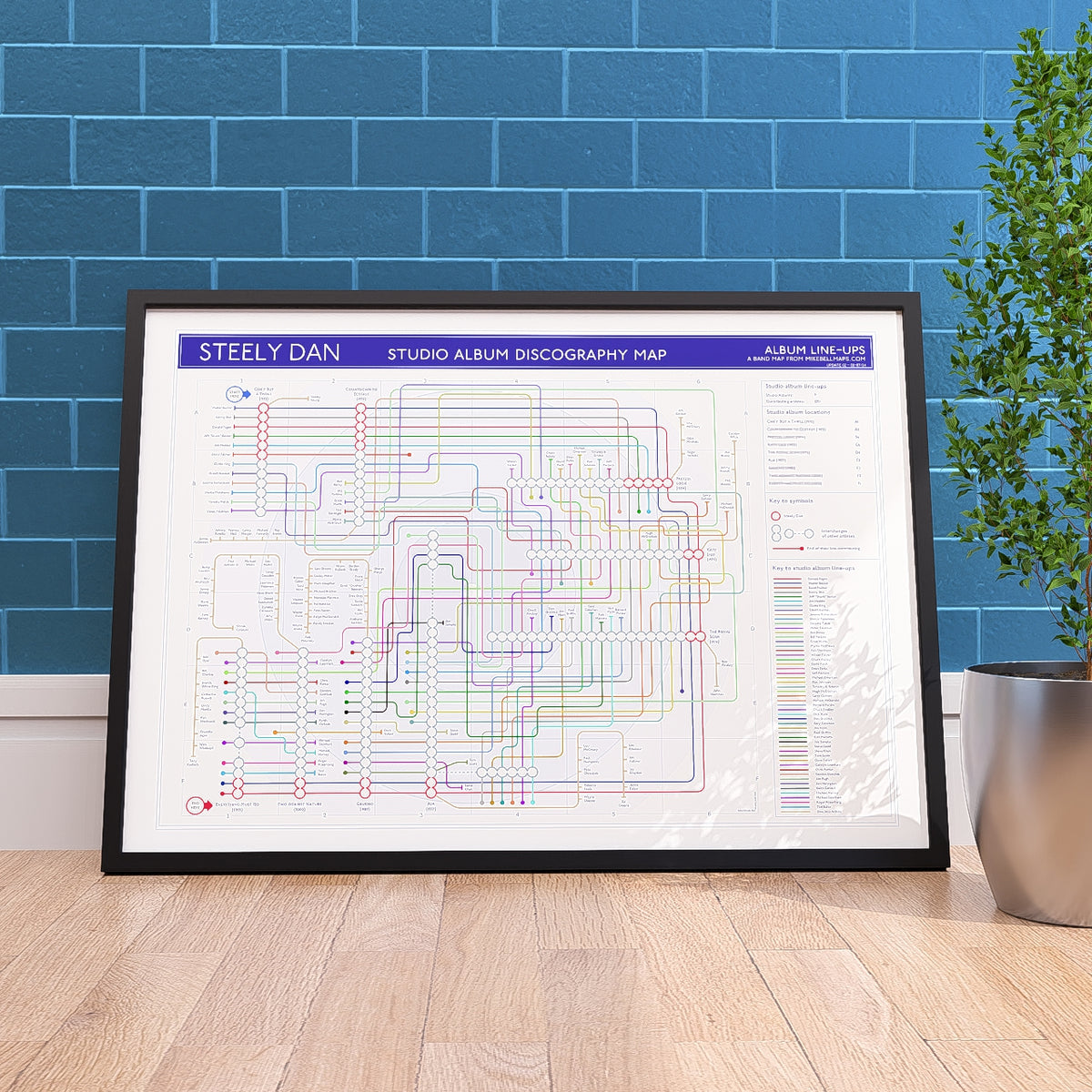
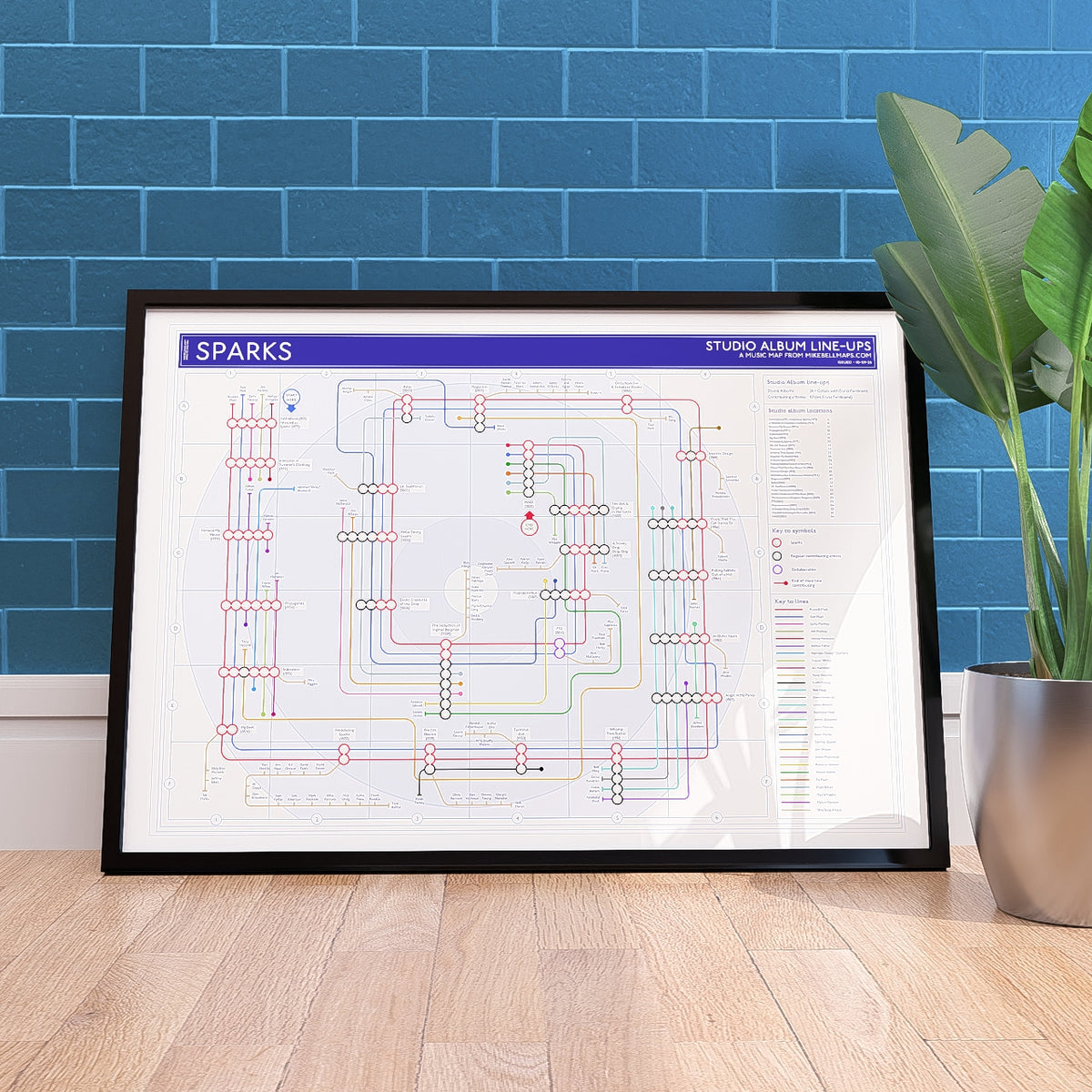
The numbers come from my own research sheets, the ones the artwork was drawn from. The Steely Dan map carries 127 credited names across only nine albums. The Sparks map spreads 87 names across 28 stations. On both, exactly two people are credited at every single station.
The nine Steely Dan stations, in order, with the credit count on each
- Can't Buy a Thrill (1972), 13 credited
- Countdown to Ecstasy (1973), 19
- Pretzel Logic (1974), 21
- Katy Lied (1975), 22
- The Royal Scam (1976), 24
- Aja (1977), 37
- Gaucho (1980), 41
- Two Against Nature (2000), 30
- Everything Must Go (2003), 22
The Sparks map runs to 28 stations rather than 26, because alongside the 26 studio albums from Halfnelson in 1971 to MAD! in 2025 the sheet also carries two releases that are not studio albums: the live Two Hands, One Mouth: Live in Europe (2012) and FFS (2015), the collaboration with Franz Ferdinand. I have set both out release by release in Sparks albums in order.

What the Sparks and Steely Dan sheets have in common, and where they part
This table comes from a fresh parse of both sheets, not from a discography listing.
| Sparks | Steely Dan | |
|---|---|---|
| The two who never leave | Ron and Russell Mael, brothers | Walter Becker and Donald Fagen, college friends |
| What the map plots | 28 stations: 26 studio albums, 1971 to 2025, plus one live album and the FFS collaboration | 9 studio albums, 1972 to 2003 |
| Total credited names | 87 | 127 |
| Credited at every station | Ron and Russell, 28 of 28, and nobody else | Becker and Fagen, 9 of 9, and nobody else |
| Busiest single release | Introducing Sparks (1977), 18 credited | Gaucho (1980), 41 credited |
| Leanest studio album | Gratuitous Sax & Senseless Violins (1994) and Exotic Creatures of the Deep (2008), 4 each | Can't Buy a Thrill (1972), 13 |
| Longest-serving hired hand | Dean Menta, guitar, 6 releases | Victor Feldman, percussion, 7 of the 9 albums |
| Shape of the line count | Mostly single figures for five decades | Climbs from 13 to 41 in eight years |
Both began as actual bands, and both line-ups were gone within six albums
This is the part people forget. Neither act is set out as a duo.
On the first two Sparks records, Halfnelson in 1971 and A Woofer in Tweeter's Clothing in 1973, the supporting cast is exactly three people: Earle Mankey on guitar, Jim Mankey on bass and Harley Feinstein on drums. Five names on the sheet, twice. After that, the three of them never appear on a Sparks release again.
Steely Dan took slightly longer to shed theirs. Jim Hodder on drums and Jeff "Skunk" Baxter on guitar are credited on the first three albums each, 1972 to 1974, and no further. David Palmer, brought in to sing the songs Fagen did not want to sing, lasts two. Denny Dias holds on the longest of the original group, from Can't Buy a Thrill in 1972 through to Aja in 1977, six albums in all.
Drawn as lines, those are short stubs at the left-hand edge of two very long sheets. On both maps, the band is a thing that happens at the start and then stops.
Steely Dan replaced the band with the best players money could find
The Steely Dan sheet has one of the steepest climbs in my whole catalogue. Can't Buy a Thrill has 13 credited musicians. By The Royal Scam in 1976 it is 24, by Aja in 1977 it is 37, and Gaucho in 1980 reaches 41.
Forty-one people on one record made by two men who had stopped touring entirely. That is the number that makes the map worth standing in front of, because it looks like a band map at first glance and turns out to be nothing of the kind.
The famous one-offs sit exactly where you would expect. Mark Knopfler plays lead guitar on a single Gaucho track and never appears again. Wayne Shorter turns up once, on Aja. Both get a branch line one station long, which is the honest way to draw a cameo.
Underneath it all, Victor Feldman is credited on seven of the nine albums, making him the most consistent presence on the map after the two principals themselves.

Sparks did the opposite, and mostly got smaller
Where Steely Dan expanded, Sparks contracted. Across five decades the Sparks sheet stays in single figures for most of its length: five, five, five, six, seven, five at the start, and six, six, nine, six, six at the end.
Two studio albums carry four credited musicians: Gratuitous Sax & Senseless Violins (1994) and Exotic Creatures of the Deep (2008). On records like those, the map is close to being two lines and a couple of branches.
The one genuine spike is Introducing Sparks in 1977, with 18 credited names, the album where the brothers hired a room full of Los Angeles session players rather than a band. It is also, as I have written elsewhere, the album where not one of those session players ever returns to a Sparks record.
Except that four of them turn up somewhere else entirely.
Four musicians appear on both the Sparks map and the Steely Dan map
This is the finding that made me want to draw the two side by side. Working through both sheets, four names cross from one to the other, and all four cross via that single 1977 Sparks album.
| Musician | On the Sparks map | On the Steely Dan map |
|---|---|---|
| Lee Ritenour | Introducing Sparks (1977) | Aja (1977), guitars |
| Ed Greene | Introducing Sparks (1977) | Aja (1977), drums |
| David Paich | Introducing Sparks (1977) | Pretzel Logic (1974) and Katy Lied (1975), piano and keyboards |
| Ben Benay | Introducing Sparks (1977) | Countdown to Ecstasy (1973) and Pretzel Logic (1974), guitar |
Ritenour and Greene are the ones I keep coming back to. Both are credited on Introducing Sparks and Aja, and both records were released in 1977. The same two players were in Los Angeles studios that year, working on an album now regarded as a high point of studio craft and on a Sparks record the brothers themselves later moved away from.
There is a near miss alongside them. Mike Porcaro is credited on Introducing Sparks, and his brother Jeff Porcaro is on three Steely Dan albums. Two sets of brothers, two maps, and the two Porcaros just failing to share a sheet.
None of this is visible in a discography. You only see it if you have plotted both sets of credits by hand and then gone looking. It is the sort of thing I have collected in my piece on session musicians who appear on more than one map.
Which other bands that became duos show up across the 70 maps
Sparks and Steely Dan are the two clearest cases, because in both the reduction is permanent and the two names left standing are credited at every station. Elsewhere the shape turns up in weaker forms: a trio that loses one member and keeps going, or a band that contracts for three albums and then refills.
What makes these two worth a print rather than a paragraph is that the contraction and the expansion happen at once. The official line-up shrinks to two while the credit count on the record climbs. A list of album titles cannot show both movements. A map drawn from the credits shows nothing else.
Why do some producers get a line, and most do not
My rule across every map is the same: a producer only earns a musician line if they are also credited playing or singing something. Producing alone, however decisive, does not put a route on the sheet.
Sparks gives the clearest example of it working. Giorgio Moroder is on the map for No. 1 in Heaven in 1979, credited for synthesiser and vocoder as well as production, so he qualifies twice over. Tony Visconti is on there too, for orchestral arrangements on Indiscreet in 1975 and again on Plagiarism in 1997, a 22-year gap between two stations on the same line.
On the Steely Dan sheet the same rule keeps the engineer Roger Nichols to a single credit, for the gong on "East St. Louis Toodle-Oo", which is my favourite example of the rule doing exactly what it should.
Which of the two maps suits which listener
Go for Steely Dan if the person reads credits for pleasure and already knows what Bernard Purdie and Chuck Rainey did to those records. The reward is watching 127 names arrange themselves around two that never move.
Go for Sparks if the appeal is endurance rather than personnel. Fifty-four years, 26 studio albums, and two brothers who kept going while every other line on the sheet started and stopped around them.
Sizes, paper and price
Both prints are a Giclée on 230gsm premium acid-free matte fine art paper with a textured finish. A3 (420 x 297 mm) is £35, unframed only. A2 (594 x 420 mm) is £45 unframed or £125 in a black wood frame. A1 (841 x 594 mm) is £65 unframed or £175 framed.
Three inch formats sit alongside the A sizes as separate options, 16 x 12 in, 24 x 18 in and 36 x 24 in, priced the same way. A1 is the one I would pick for either of these two, because both sheets carry a great many short names and the reading time is in the branch lines.
The two maps in this piece
Sparks discography art print, 28 stations, 26 studio albums from 1971 to 2025 plus a live album and the FFS collaboration, 87 credited names.
Steely Dan discography art print, 9 studio albums and 127 credited names, 1972 to 2003.
Questions about these two maps
Are Ron and Russell Mael really on every Sparks station?
Yes, all 28 of them, which is more than any other name on the sheet by a distance. The next longest line belongs to Dean Menta on six.
Are Becker and Fagen on all nine Steely Dan albums?
Yes, both of them, on every one from 1972 to 2003. They are the only two names on the sheet that manage it. Walter Becker died in 2017.
What is not on these maps?
Compilations and soundtracks are left off both, so the Annette soundtrack and any musician credited only on it do not appear on the Sparks map. The Steely Dan map plots the nine studio albums and nothing else. The Sparks map is the exception to my usual studio-only rule, because it carries Two Hands, One Mouth: Live in Europe (2012) as a station. Solo records are outside both sheets, so Donald Fagen's own albums and the Mael brothers' film work are absent, and producers with no playing credit never get a line.
Why does Steely Dan have more musicians than Sparks on a third of the albums?
Because they were buying something else. Sparks kept a small circle and constantly changed style. Steely Dan kept the style tight and changed the personnel on almost every track until it sounded the way they wanted.
Where do the numbers come from?
From my own research sheets, built by hand from album credits over several years, and they are the sheets the artwork was drawn from rather than a database export. There is no AI at any stage.
Related reading and maps
For each act on its own, I have written up Sparks albums in order and Steely Dan albums in order.
If the pattern itself is the interesting part, how many musicians play on an album compares the counts across all 70 maps, and which bands never changed their line-up looks at the opposite case entirely.
Both prints sit in the Music Wall Art Prints collection. If you are buying for someone and cannot choose between the two, a gift card for music fans passes the decision to them.


