



Bob Marley Discography Tube Map Art Print
- Precio regular
-
£42.00 - Precio regular
-
- Precio de venta
-
£42.00
No se pudo cargar la disponibilidad de recogida
Add a second Tube Map print - Save 20% applied automatically at checkout, no code needed.
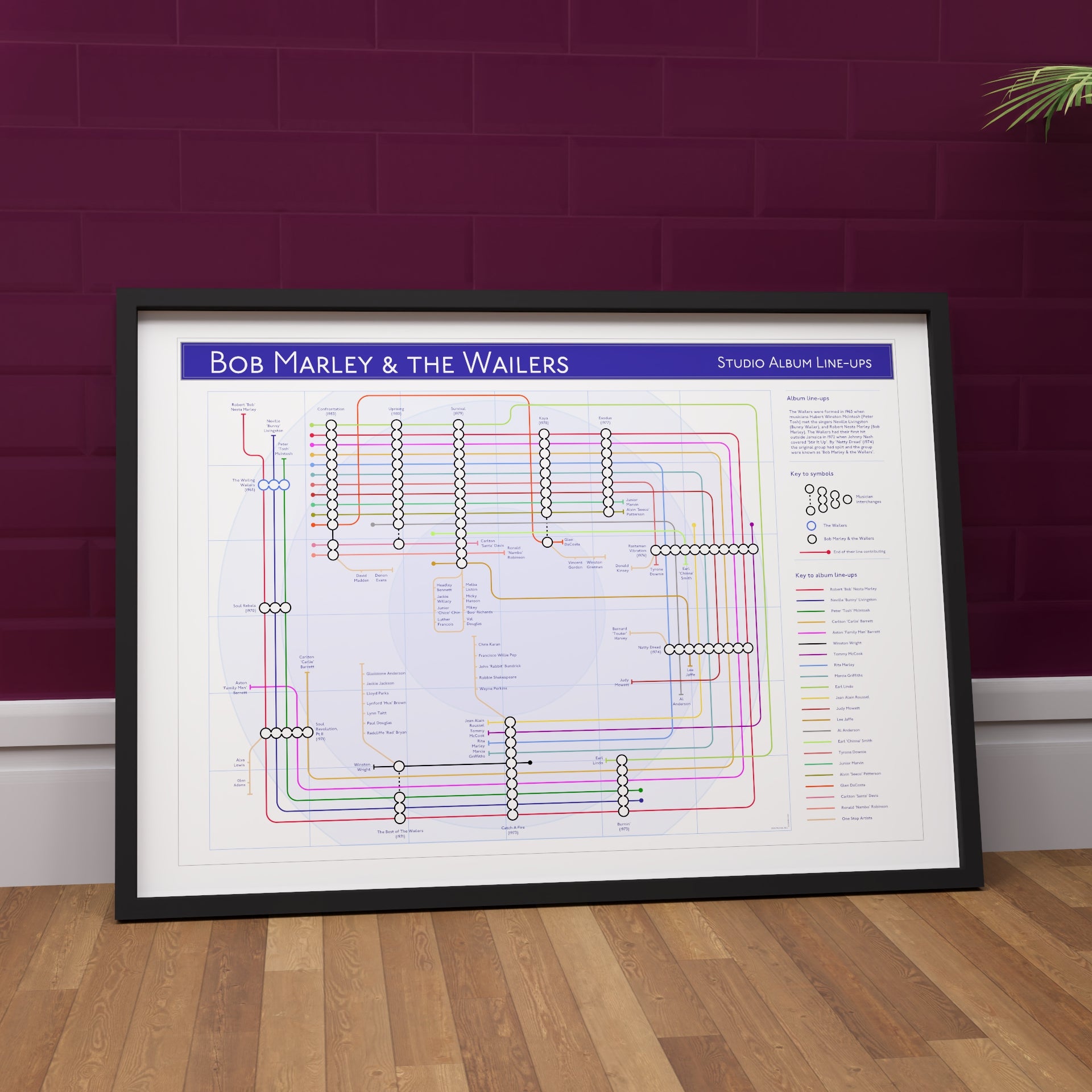
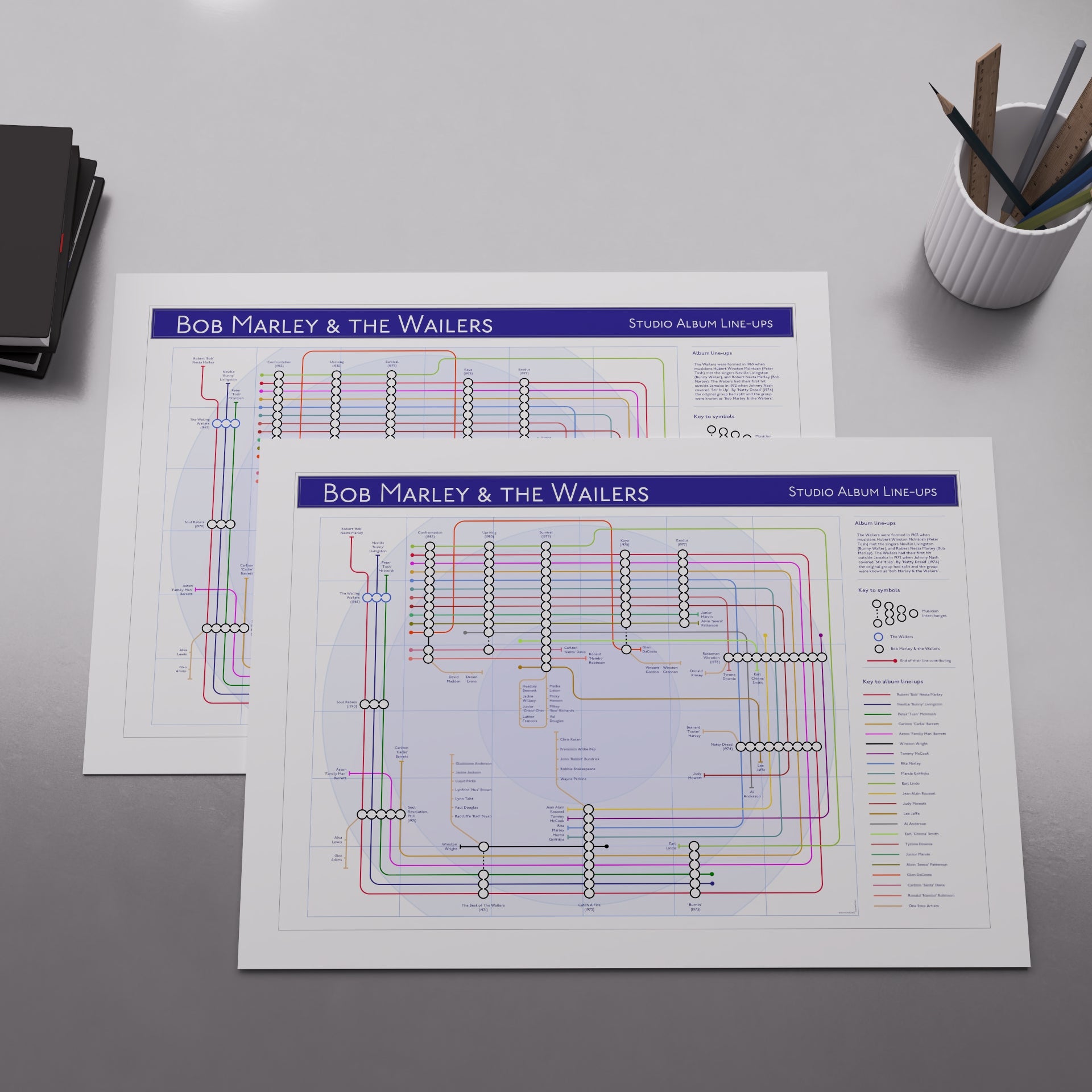
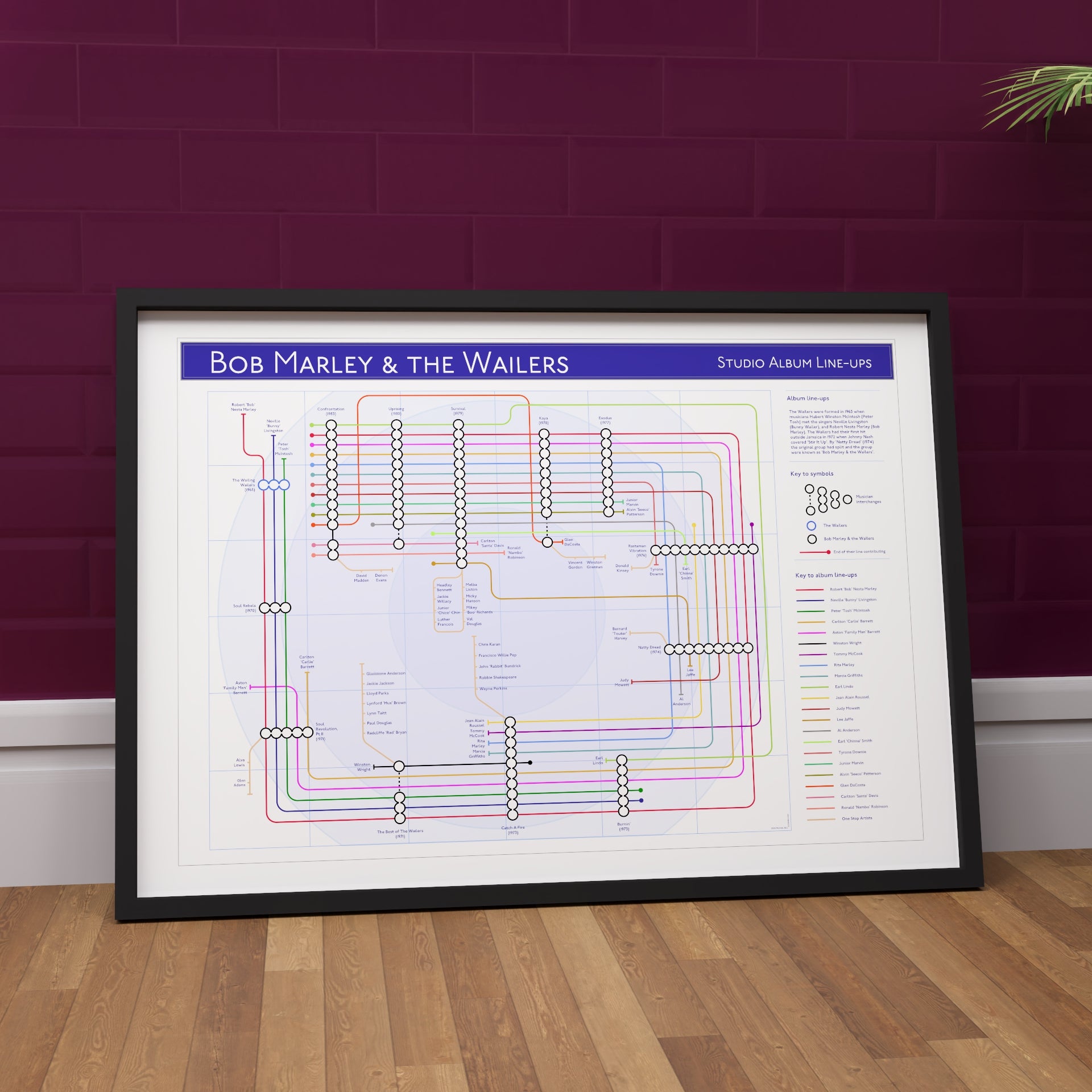
A gift for Bob Marley fans who think of the Wailers as three men, because this runs all 13 albums with every credited musician as their own line. They own the records already, and the band grows from three names to twenty-three.
Giclée on 230gsm premium fine art paper, textured matte, archival and acid-free. Produced unframed or framed. Deeply researched and designed by me in East Sussex.
I plot these in CAD software. Every credited musician becomes a transit line, every album becomes a station, and anyone who appears only once gets a branch line of their own.
The stations run chronologically from The Wailing Wailers in 1965, through Catch a Fire and Exodus, to Confrontation in 1983.
Why this Bob Marley discography tube map art makes a gift fans keep
The shape of this map is the story of reggae going global. The first two albums credit three musicians between them. By Survival in 1979 there are 23 on one record.
Almost none of that expansion is visible on a sleeve. It rewards every closer look.
Contributing musicians on the map
Bob Marley, Peter Tosh and Bunny Wailer run as three parallel lines through the early records, with nothing else beside them. Tosh and Bunny both stop after Burnin' in 1973, and from there Marley's is the only original line left.
The Barrett brothers hold the whole thing together. Aston “Family Man” Barrett on bass and Carlton Barrett on drums run from Soul Revolution right through to the final album.
The I-Threes are all three on the map: Rita Marley, Marcia Griffiths and Judy Mowatt, whose backing vocal lines carry almost every record from the mid-1970s onward.
Catch a Fire is the record where the map widens into rock. Wayne Perkins plays the guitar overdubs, John “Rabbit” Bundrick plays keyboards, and Robbie Shakespeare plays bass on Concrete Jungle alone.
Junior Marvin, Tyrone Downie and Alvin “Seeco” Patterson join at Exodus and stay to the end, with Al Anderson's lead guitar coming and going across four albums.
Survival in 1979 is the widest station on the print, adding a full horn section including the jazz trombonist Melba Liston, Glen Da Costa, Ronald “Nambo” Robinson and Junior “Chico” Chin.
How I make each print
Each one is a Giclée on 230gsm premium fine art paper with a textured matte finish, archival and acid-free, so the colours hold for years. Choose A2 or A1, unframed or framed, ready to hang in a hallway, living room or studio.
| Size | UK | USA / CAN / AUS equivalent | Orientation |
|---|---|---|---|
| A2 | 594 x 420 mm (23 x 16 in) | 24 x 18 in | Landscape |
| A1 | 841 x 594 mm (33 x 23 in) | 36 x 24 in | Landscape |
FAQ
When did Tosh and Bunny Wailer leave?
Both lines end after Burnin' in 1973. Marley's continues alone through the remaining albums.
How are the maps drawn?
In CAD software, plotted line by line. Every credited musician is a transit line, every album a station, and one-off contributors branch off the main routes.
Who are the I-Threes?
Rita Marley, Marcia Griffiths and Judy Mowatt, all three of whom appear on the map from the mid-1970s onward.
Which album has the most musicians?
Survival in 1979, with 23 credited players, including a nine-piece horn section.
Who plays the rock guitar on Catch a Fire?
Wayne Perkins, who later turns up on a Rolling Stones album. John “Rabbit” Bundrick, later of The Who, plays keyboards on the same record.
Who is on every album after 1971?
Aston “Family Man” Barrett and his brother Carlton, on bass and drums.
What are the framing options?
Unframed, or supplied framed and ready to hang.
Related Music Maps
Browse the full range of gifts for music fans at the Gifts for Music Fans collection and the Music Icons collection at mikebellmaps.com.
Because Wayne Perkins and John “Rabbit” Bundrick both appear on Catch a Fire, the Rolling Stones Discography Map Art Print and the Who Discography Map Art Print are unexpected companion pieces.
What people say about my tube map designs
“Brilliant idea... really like what you’ve done, Mike.”
Billy Bragg, on the Billy Bragg discography map
“It is truly amazing.”
Bruce Springsteen Archives, Monmouth University, on the Bruce Springsteen discography map
“Awesome!”
Warren Ellis, on the The Shining plot map








Let customers speak for us

Great gift for a Bowie fan ! Very nicely done and item was well packaged and arrived in Canada quickly. Totally satisfied.
Having seen your work in the Guardian a few weeks previously and looked at your website, it didn't take much to press the 'Add to bag' button and easily make my purchase. It arrived in good time and well wrapped. Thank you!

This was a gift for someone who is so hard to buy for and he loves it. It's almost as though it was made for him alone! It's so clever! Thank you
Couldn't have been easier. Got it really quickly as far as I'm concerned, and given the cost of custom framing, the money for having this delivered framed was well spent. The print arrived in excellent condition, frame and all.

Incredible detail. I'm still studying it! Worth every penny.

This was a gift for my dad. He loved it! Amazing quality and the time it must have taken to research is evident. Thank you
Love this type of stuff
Fast and great shipping

Very well received from my brother in law as a birthday gift.
Arrived well in time and Mike replied to my email quickly and was very helpful.
fast delivery and tracking available all the way
Great piece of work, a lot of research and precision.
Beautiful, clean design and quality printing
Maybe having the role of the contributing artist would helpful

Bloody spot on cobba, I put my best Hawkwind mate on to you, I couldn't afford framed but I do it my end Thanks mate 👍, just a question for you, have many from Australia brought Hawkwind 👍
Good service. Kept me well informed.
Perfect - just as pictured

Excellent product and clear, quick delivery process. Couldn’t ask for more.


